Albany Records ProjectPublic-records desk for Albany, Oregon
Records
  • Search SourcesSearch names, agencies, contracts, meetings, budgets, and files in one place.
  • Packet GuidesPlain-language, item-by-item guides to city meeting packets, with page numbers and source links.
  • Meetings & AgendasFind upcoming meetings, agendas, access notes, and source-backed public comment tools.
  • ALPR Ordinance DashboardFollow the cancelled license plate camera contract, the council vote, and what is still pending.
  • ARA WatchFollow CARA grant money: awards, board votes, deadlines, and records still needed.
  • Track the Record TrailFollow our records requests: replies, fees, denials, and appeals.
  • Watch TermsGet an alert when new records match the terms you follow.
  • Sources LibraryCity packets, budgets, and policies — reviewed and searchable in one library.
  • Strategic Plan WatchTrack Albany's 2026–2030 goals by owner, deadline, budget, and proof.
  • Vote the Next PriorityTell us which issues we should work on next.
Take Action
  • Start an Issue FileTell us about an issue, a missing record, or where to look next.
  • Self-Help Eviction IntakeConfidential intake if you were locked out, shut off, or forced to move.
  • ARP FeedbackSend ideas, bug reports, or suggestions for the site.
Read
  • EducationPlain-language basics on public records and how to take part in local government.
  • ArticlesSource-backed reporting, checked against documents before it is published.
  • ExplainersStep-by-step guides to Oregon's civic rules, in plain words.
  • Topic HubsRecords, sources, and articles grouped by the questions people ask most.
  • VideosClips, highlights, and public comment from local council meetings.
  • MusicLocal audio: community soundtracks and podcasts.
About Us
Search recordsFund the Desk
Albany Records Project

A neighbor-funded desk that finds, checks, and publishes Albany's public records — so anyone can see how local decisions get made.

About ARP

  • About
  • Fund Records Fees
  • Partners & Sponsors
  • Feedback
  • Press
  • Contact

Search & Act

  • Search Records
  • Track Requests
  • Source Library
  • Strategic Plan Watch
  • Send a Tip
  • Tenant Self-Help
  • Lockout & Removal Intake
  • Vote a Priority
  • Participate in Meetings

Read & Learn

  • Education
  • Explainers
  • Articles
  • Topic Hubs
  • Music
  • Videos
  • Terms & Conditions
  • Privacy Policy
  • Privacy Choices
  • Privacy Requests

Disclaimer: The Albany Records Project is an independent civic research and journalism organization. We are not a law firm and nothing here is legal advice. Tips are treated as leads to check, not as proof. Before anything is published, we review it for source reliability, litigation holds, redactions, and consent. To report an error or ask for a correction, contact the records desk.

© 2026 Albany Records Project · Source-backed records desk · Albany, Oregon

Skip to main content
Albany Records ProjectPublic-records desk for Albany, Oregon
Sign InSign Up
  • Search SourcesSearch names, agencies, contracts, meetings, budgets, and files in one place.
  • Packet GuidesPlain-language, item-by-item guides to city meeting packets, with page numbers and source links.
  • Meetings & AgendasFind upcoming meetings, agendas, access notes, and source-backed public comment tools.
  • ALPR Ordinance DashboardFollow the cancelled license plate camera contract, the council vote, and what is still pending.
  • ARA WatchFollow CARA grant money: awards, board votes, deadlines, and records still needed.
  • Track the Record TrailFollow our records requests: replies, fees, denials, and appeals.
  • Watch TermsGet an alert when new records match the terms you follow.
  • Sources LibraryCity packets, budgets, and policies — reviewed and searchable in one library.
  • Strategic Plan WatchTrack Albany's 2026–2030 goals by owner, deadline, budget, and proof.
  • Vote the Next PriorityTell us which issues we should work on next.
  • Start an Issue FileTell us about an issue, a missing record, or where to look next.
  • Self-Help Eviction IntakeConfidential intake if you were locked out, shut off, or forced to move.
  • ARP FeedbackSend ideas, bug reports, or suggestions for the site.
  • EducationPlain-language basics on public records and how to take part in local government.
  • ArticlesSource-backed reporting, checked against documents before it is published.
  • ExplainersStep-by-step guides to Oregon's civic rules, in plain words.
  • Topic HubsRecords, sources, and articles grouped by the questions people ask most.
  • VideosClips, highlights, and public comment from local council meetings.
  • MusicLocal audio: community soundtracks and podcasts.
About Us
Fund the Desk
Sign InSign Up
Records
  • Search SourcesSearch names, agencies, contracts, meetings, budgets, and files in one place.
  • Packet GuidesPlain-language, item-by-item guides to city meeting packets, with page numbers and source links.
  • Meetings & AgendasFind upcoming meetings, agendas, access notes, and source-backed public comment tools.
  • ALPR Ordinance DashboardFollow the cancelled license plate camera contract, the council vote, and what is still pending.
  • ARA WatchFollow CARA grant money: awards, board votes, deadlines, and records still needed.
  • Track the Record TrailFollow our records requests: replies, fees, denials, and appeals.
  • Watch TermsGet an alert when new records match the terms you follow.
  • Sources LibraryCity packets, budgets, and policies — reviewed and searchable in one library.
  • Strategic Plan WatchTrack Albany's 2026–2030 goals by owner, deadline, budget, and proof.
  • Vote the Next PriorityTell us which issues we should work on next.
Take Action
  • Start an Issue FileTell us about an issue, a missing record, or where to look next.
  • Self-Help Eviction IntakeConfidential intake if you were locked out, shut off, or forced to move.
  • ARP FeedbackSend ideas, bug reports, or suggestions for the site.
Read
  • EducationPlain-language basics on public records and how to take part in local government.
  • ArticlesSource-backed reporting, checked against documents before it is published.
  • ExplainersStep-by-step guides to Oregon's civic rules, in plain words.
  • Topic HubsRecords, sources, and articles grouped by the questions people ask most.
  • VideosClips, highlights, and public comment from local council meetings.
  • MusicLocal audio: community soundtracks and podcasts.
About Us
Search recordsFund the Desk
Albany Records Project

A neighbor-funded desk that finds, checks, and publishes Albany's public records — so anyone can see how local decisions get made.

About ARP

  • About
  • Fund Records Fees
  • Partners & Sponsors
  • Feedback
  • Press
  • Contact

Search & Act

  • Search Records
  • Track Requests
  • Source Library
  • Strategic Plan Watch
  • Send a Tip
  • Tenant Self-Help
  • Lockout & Removal Intake
  • Vote a Priority
  • Participate in Meetings

Read & Learn

  • Education
  • Explainers
  • Articles
  • Topic Hubs
  • Music
  • Videos
  • Terms & Conditions
  • Privacy Policy
  • Privacy Choices
  • Privacy Requests

Disclaimer: The Albany Records Project is an independent civic research and journalism organization. We are not a law firm and nothing here is legal advice. Tips are treated as leads to check, not as proof. Before anything is published, we review it for source reliability, litigation holds, redactions, and consent. To report an error or ask for a correction, contact the records desk.

© 2026 Albany Records Project · Source-backed records desk · Albany, Oregon

  1. Home
  2. /Articles
  3. /You Don't Have to Be a Lawyer to Read the Law
Back to articles
Oregon legal literacy

You Don't Have to Be a Lawyer to Read the Law

SharefXin@

Albany police shared a legal-myths post. Here is what it gets right, where Oregon law needs more precision, and how anyone can check the sources.

July 11, 2026Albany Records Project12 min read4 sources
laworegonpolice-accountabilityknow-your-rightslegal-auditors

Source review completed July 11, 2026

Illustrated Oregon legal-literacy poster with an open law book and the words Read it, Check it, Share it.

In brief Albany police shared a popular "legal myths" post that gets many basics right but compresses several Oregon rules too far. Here is a source-by-source check—and a guide for anyone who wants to read the law firsthand.

You do not have to be a lawyer to read, quote, discuss, or share statutes and court opinions. Lawyers bring training, judgment, and duties to a client's particular facts. The law itself, however, is public. This article links readers to that law; it does not tell anyone what to do in a specific encounter or case.

The post under review

Albany Police Department on Facebook. Facebook may set cookies or collect usage data when the post loads.

If the embed does not appear, read the original post on Facebook.

The post has a useful goal: correct legal misconceptions people pick up from television and social media. Much of it succeeds. Miranda warnings are not triggered simply by the appearance of handcuffs. A missing warning does not automatically end a prosecution. Calling driving "traveling" does not create a licensing exemption. Paying taxes does not make a resident an officer's supervisor. Police investigate; courts determine guilt.

The trouble begins where a short, confident answer leaves out an Oregon rule that changes the meaning. If the lesson is “check what the law actually says,” the official post should meet that standard too.

Contents

Who decides a trial?

The clearest correction comes at the end of the post:

[!quote] "A jury decides the outcome if it does go to trial."

That is often true, but not always. allows a criminal defendant, with the trial judge's consent, to waive a jury and be tried by the court. also addresses that election. A jury may decide guilt at trial; in a lawful bench trial, the judge does.

Probable cause must connect a person to an offense

The post says officers can arrest when “there is probable cause that a crime has been committed or a warrant exists.” Read literally, that leaves out half the standard. requires “a substantial objective basis for believing that more likely than not an offense has been committed and a person to be arrested has committed it.” The facts must connect the person being arrested to the offense. Federal law follows the same basic rule. See (1964).

Oregon adds another limit. says that, except as allows, “a person may not be arrested for a violation.” ORS 810.410(3)(a) is even plainer: “A police officer may not arrest a person for a traffic violation.” For ordinary speeding and most equipment or registration violations, an officer may investigate, identify the driver, and issue a citation—but not make a custodial arrest for the violation itself. Traffic crimes, including DUII or reckless driving, are different.

When identification is required

On identification, the post begins with “sometimes that's true” but may leave readers with the impression that lawful detention generally creates a duty to identify yourself. Oregon has no general stop-and-identify statute. lets an officer with reasonable suspicion “make a reasonable inquiry,” but it does not itself require a pedestrian to answer.

Specific rules still apply. Drivers must present a license (), and giving false identifying information can be an offense (; ). Even then, ORS 807.570(4) limits detention to the time “reasonably necessary to investigate and verify the person's identity.” The distinction is simple: an officer's authority to ask is not always the same as a person's legal duty to answer.

Refusal is not automatically resisting

The post says that “physically pulling away, refusing lawful commands during an arrest, or actively preventing officers from placing someone into custody may also constitute resisting.” Those examples should not be grouped together without qualification.

The important distinction Two of those examples need important qualifications. defines "resists" as "the use or threatened use of violence, physical force or any other means that creates a substantial risk of physical injury," then states: "Passive resistance does not constitute behavior intended to prevent being taken into custody." A refusal, without force or active measures, may qualify as passive resistance; the facts and the charge still matter.

Oregon's interfering-with-a-peace-officer statute () uses the same carveout. In (2017), the Oregon Supreme Court held that a man who refused an officer's order to leave was entitled to a passive-resistance instruction. The concept is not limited to organized protest.

“Pulling away” is more fact-dependent. It can cross into resisting when the conduct creates a substantial risk of injury or goes beyond passive noncooperation. See State v. Hutchinson, 94 Or App 441 (1988). The key point is narrower than “refusal equals resisting”: the conduct, risk, intent, and surrounding facts matter.

Handcuffs: context matters

The post is right that handcuffing, a search incident to arrest, or placement in a patrol car does not automatically establish a constitutional violation. The missing half is equally important: those acts are not automatically lawful.

Under , a stop is not the same as an arrest. Oregon cases recognize that the degree of restraint—including handcuffing or confinement in a patrol car—can turn a stop into an arrest that requires probable cause. See State v. Morgan, 106 Or App 138 (1991), and State v. Johnson, 120 Or App 151 (1993). Any force used is separately evaluated for objective reasonableness under the totality of the circumstances. ; (2025).

Note “Not automatically a violation” and “automatically lawful” are different statements. Context determines the answer.

Oregon law can go beyond the federal floor

Several gaps share a cause: the post states a familiar federal rule without fully accounting for Oregon law. is interpreted independently and, in some areas involving searches, seizures, and interrogation, provides protections beyond the federal minimum.

Miranda is the vivid case. The post gives the federal "custody plus interrogation" test. Article I, section 12 also requires warnings in "compelling circumstances" that can exist before an encounter counts as federal custody — a rule the Oregon Supreme Court reaffirmed as recently as (2026), which refused to treat even a hospital emergency room as a categorical safe harbor from the warning.

Consent searches make the point in black letter. Oregon wrote it into both the general stop statute () and the traffic-stop statute (): an officer may request consent to search "only if the officer first informs the person that the person has the right to refuse," and must record that consent. The Fourth Amendment requires no such warning — a concrete instance, on every stop, of Oregon handing residents more protection than the post's federal-floor framing lets on.
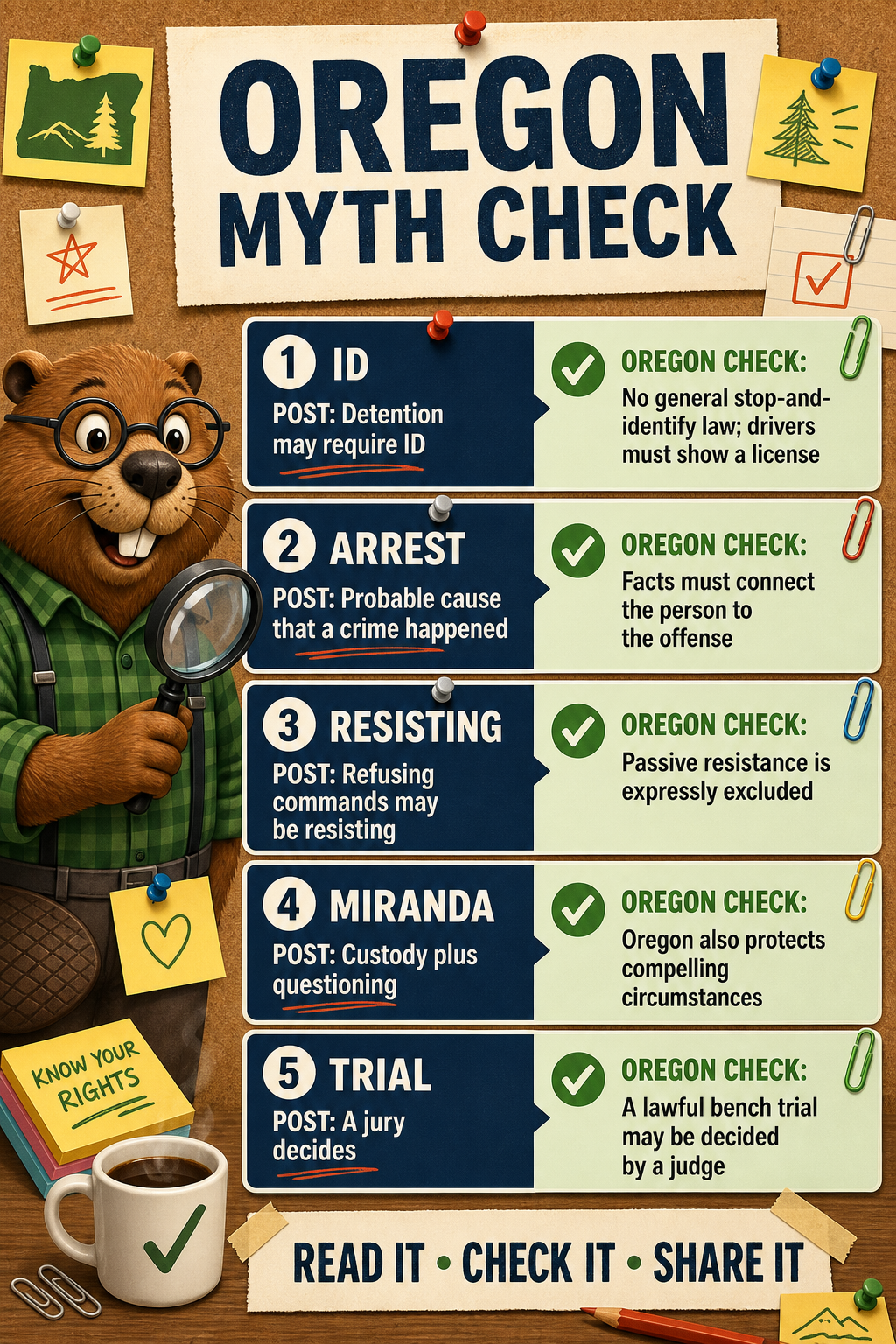
A playful Oregon myth-check infographic compares five statements from the police post with more precise Oregon rules about identification, arrest, resisting, Miranda warnings, and bench trials.

Five claims, five source checks. These are short summaries; the linked statutes and opinions below provide the controlling text and context.

Why an official page should be especially careful

An official page carries institutional weight. Residents may reasonably treat an agency's legal explainer as more reliable than an anonymous comment, which makes careful, jurisdiction-specific wording especially important.

In civil-rights litigation, municipal liability can involve evidence of policy, custom, or training (, 1978). A social-media post alone does not establish municipal liability, and whether it is relevant or admissible depends on the facts and claims. Still, an official explainer can become part of the public record examined when an agency's policies or training are disputed.

Sharing also expands the post's audience. A link to Oregon authority—and a brief note that the summary is general—would give readers a direct route to the governing text.

Learn the law yourself: a plain-English guide

Reader guide The point is not to win a roadside argument. It is to help residents and officers check the law before an encounter, complaint, report, or court date. Each row offers a starting point, followed by the authority to read next.

The questionWhat Oregon law actually saysRead next
Talking to police comes in three levelsA conversation (no suspicion needed — you're free to walk away), a stop (needs reasonable suspicion of a specific crime), and an arrest (needs probable cause). A stop is a seizure, but a stop is not an arrest., ; ;
Do I have to give my name?On the street, generally no — Oregon has no stop-and-identify law, and staying silent isn't a crime. If you're driving, you must show your license on request, and the officer may detain you only as long as reasonably necessary to verify your identity. A false name to police is a crime.; ; ;
Do officers have to identify themselves?Oregon law includes identification duties for officers in specified circumstances: providing a name and identification number or business card on request when safe, helping identify an officer from partial information, and displaying identification during crowd control. A 2026 law adds uniform-identification and face-covering rules with stated exceptions.; ;
When can they arrest me?Only with a valid warrant, or probable cause that you committed a specific offense. "A crime happened somewhere" is not enough.; ;
Can they arrest me over a traffic ticket?For a traffic violation (speeding, most equipment/registration): no — investigate, identify, cite. For a traffic crime (DUII, reckless, criminal driving while suspended): yes.; ;
SearchesGenerally need a warrant, your voluntary consent, or a recognized exception. On any stop, the officer must tell you that you can refuse before asking, and record consent. "Search incident to arrest" is limited to safety, evidence of the crime of arrest, and escape — not a blank check — and phones generally need their own warrant., ; ;
Miranda warningsRequired before questioning someone in custody — not at the instant of arrest, and not on a routine stop. Oregon goes further: warnings are also required in "compelling circumstances" short of formal arrest. A missing warning usually suppresses a statement, not the case.; ;
Resisting arrestNeeds force, a threat of force, or conduct creating a substantial risk of injury, and you must know it's an officer. Passive resistance — refusing, going limp, arguing — is excluded. You still may not use physical force to resist, even an unlawful arrest.; ; ; ;
Handcuffs and the patrol carNot automatically a rights violation — and not automatically lawful; handcuffing and confinement can turn a stop into an arrest that then needs probable cause.; State v. Morgan; State v. Johnson
Criticizing or recording policeProtected speech; it cannot, by itself, justify arrest or force.[U.S. Const. amend. I]; ;
Use of forceMust be objectively reasonable under the totality of the circumstances — the whole encounter, not just the final second.;
How a case actually endsPolice investigate and refer; the DA decides charges; the judge decides legal questions; guilt at trial is decided by a jury or, on waiver, by the judge.;
"Traveling, not driving"Not a legal category. Driving on public roads needs a license — a traffic violation if you don't (). Real exemptions exist (out-of-state visitors, military, farm tractors, bicycles: ) but "traveling" isn't one.; ;
Why official wording mattersAn official statement may be examined alongside other evidence when policy, custom, or training is disputed. One post does not establish municipal liability by itself.

The through-line Federal law is only the starting point. Oregon statutes and the Oregon Constitution may add protections or impose different limits. Read both before treating a short summary as the whole rule.

Bottom line

The post is a well-meant civics lesson, and most of its basic advice survives review. The needed corrections are specific: probable cause must connect the person to the offense; a traffic violation is not itself grounds for custodial arrest; Oregon has no general stop-and-identify law; passive resistance is excluded from the resisting-arrest definition; Oregon interrogation and consent-search rules can go beyond the federal floor; and a judge may decide guilt in a lawful bench trial.

The answer is not less public education. It is public education with links, qualifications, and Oregon law included. The post's best line supplies the standard:

[!quote] "What you believe about your rights may not always match what the law actually says. Before relying on something you've heard, it's worth checking whether it's actually supported by your state's laws and court decisions."

That advice belongs to all of us—residents, officers, agencies, and writers alike.

Authorities

Method Statutes were checked against the 2025 ORS text and relevant 2026 Oregon Laws; cases were checked against published opinions. The links below provide direct reading copies. Because the 2025 ORS compilation does not yet incorporate every 2026 session change, current-law research should check both the codified text and the 2026 session laws.

Statutes & constitution: · · · · · · · · · · · · · · · · · · · · · (§§ 8, 9, 11, 12); U.S. Const. amends. I, V.

Cases: , 311 Or 400 (1991) · , 293 Or 741 (1982) · , 361 Or 314 (2017) · State v. Hutchinson, 94 Or App 441 (1988) · State v. Morgan, 106 Or App 138 (1991) · State v. Johnson, 120 Or App 151 (1993) · , 375 Or 173 (2026) · , 379 U.S. 89 (1964) · , 384 U.S. 436 (1966) · , 490 U.S. 386 (1989) · , 482 U.S. 451 (1987) · , 573 U.S. 373 (2014) · , 605 U.S. 73 (2025) · , 176 F.3d 1202 (9th Cir. 1999) · , 436 U.S. 658 (1978).

This article is supported by public records, source review, and neighbor-funded records work. Source gaps stay visible until the next record closes them.

Record trail

Public records and source pages used for this article.

www.facebook.com/albanypd/posts/pfbid02HdaVJFkaMp2REKA8PjRnMQ3jGs74SVDb5MHschfkBFSMXaSryFZW91DrY48xYmPnlSource pagewww.oregonlegislature.gov · ors131.htmlSource pagewww.oregonlegislature.gov · ors162.htmlSource pagewww.oregonlegislature.gov · ors810.htmlSource page

Next civic step

Search the source trail, submit a missing public record, or help fund the next records request.

Search sourcesSubmit a source lead